Quick Answer
If you are looking for the best Qhira build in HOTS and how to use her swings and bleed pressure without overfeeding, this guide breaks it down in a practical, real-match way. Qhira is a melee assassin who wins through brutal duels, sustained bleed pressure, and the kind of skirmish control that makes overextended targets feel trapped with her for too long.
This guide helps you stop diving at random on Qhira and start using her grapples, bleed windows, and isolation pressure where they actually take over fights.
She feels strongest when one target thinks the duel will be short and then suddenly realizes Qhira is still attached, still cutting, and still winning it.
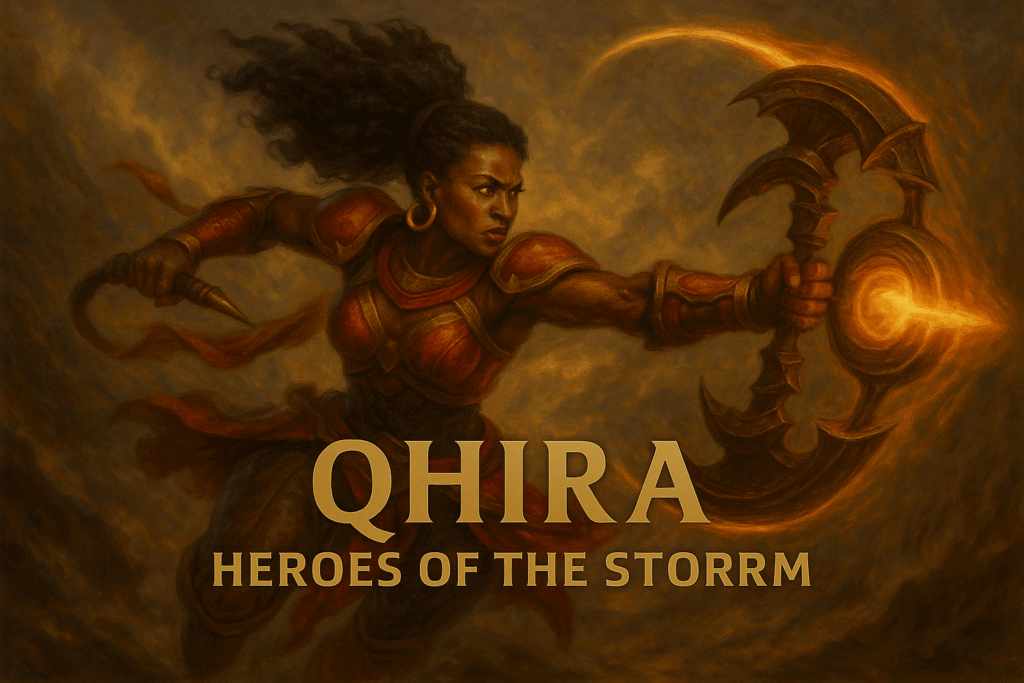
Hero Identity and Role Breakdown
Qhira is dangerous because she makes short mistakes last too long. Bleeds, self-healing, and grappling control let her keep pressure on targets that wanted a quick trade and a clean exit. When she gets an isolated target or an overextended frontliner, the fight can start feeling very one-sided very quickly.
She becomes much worse when those windows are forced. If you attach into untouched peel, spend mobility before the real punish starts, or brawl in the middle of five people because one swing looked cool, Qhira stops feeling predatory and starts feeling exposed.
Qhira Abilities Explained
Grappling Hook (Trait - D) Qhira can hook to terrain, enemies, or structures to swing and reposition. Carnage (Q) Qhira spins her chainblade, dealing damage to nearby enemies and healing based on Bleeding stacks. Blood Rage (W) Qhira's next Basic Attack deals bonus damage and causes the target to Bleed. Revolving Sweep (E) Qhira swings around her target, dealing damage and applying Bleeding to enemies hit. Unrelenting Strikes (R1) Qhira becomes Unstoppable and strikes repeatedly, with the final hit dealing massive damage. Final Strike (R2) After a delay, Qhira teleports to target enemy and deals damage based on their missing health.
Qhira is built around sticking to the right target for longer than they wanted. The first connect matters, but the hero becomes brutal when bleed pressure and mobility control keep the duel alive on her terms.
How to Play Qhira (Step-by-Step)
- Open on targets who are truly isolated enough to let the bleed and swing matter
- Use your swing to control the angle of the duel, not just to start it
- Keep the bleed running on targets that cannot cleanly disengage yet
- Save your full commitment for the hero whose peel or escape already broke
- Exit the scrum once the duel stops being yours instead of pretending it still is
How to Play Qhira Effectively
In lane and early skirmishes, Qhira gets the most value from forcing uneven trades that last just long enough for her bleed and sustain to matter. She is not trying to be a frontliner. She is trying to make one target regret staying close even a little longer than they should have.
In teamfights, she wins when one target is stranded, overextended, or poorly covered by peel. Once the grapple and bleed pressure are real, the enemy has to solve both the duel and the rest of the fight at the same time. That overlap is exactly where Qhira can win fights by herself against teams that answer too slowly.
Around objectives, she loves split lines and messy side angles. If a frontliner or backliner drifts just far enough from real support, Qhira can turn that into a full skirmish that the enemy did not want happening yet. The more fractured the fight becomes, the better her chances usually get.
The beginner-friendly version is simple: duel the target that is actually isolated, respect the peel you did not force yet, and leave the angle once the fight stops belonging to you.
In some games, Qhira can feel strong in every skirmish and still not close enough - that is normal. She starts taking over once the enemy stops cleanly peeling the target she wants to keep trapped.
Best Qhira Builds (Level 1 to 20)
The Hunted at level 1, Upstage at level 4, Finishing Touch at level 7, Unrelenting Strikes at level 10, Chainsaw at level 13, Swing Life Away at level 16, No Sanctuary at level 20
Gameplay Focus - Blood for Blood (Sustain Duelist)
Self-Sustain, Extended Duels, Bleeding Amplification
This build transforms Qhira into an unstoppable dueling machine that grows stronger as fights progress. The foundation lies in maximizing Bleeding application and leveraging those stacks for both damage and sustain. The Hunted provides crucial early game survivability while marking high-value targets for bonus damage, making trades heavily favor Qhira. Upstage gives your Revolving Sweep incredible utility, allowing you to gap-close and stick to targets while building Bleeding stacks. Finishing Touch is the key talent that makes low-health enemies incredibly vulnerable - the bonus damage and healing from Carnage against wounded foes creates a snowball effect where successful trades lead to dominant positions. Unrelenting Strikes becomes your dueling ultimate, providing Unstoppable frames and massive damage that scales with enemy missing health. The build peaks with Swing Life Away at 16, which gives you unprecedented sustain by making Carnage heal based on enemy maximum health rather than just your Bleeding stacks. This creates scenarios where fighting multiple enemies actually heals you more than fighting one.
The Hunted : Marks provide bonus damage and movement speed, perfect for sustained fights. Upstage : E gains range and slow, making it impossible for enemies to escape. Finishing Touch : Carnage deals massive damage and healing to wounded enemies. Unrelenting Strikes : Unstoppable ultimate that scales with enemy missing health. Chainsaw : W gains range and hits multiple targets, spreading Bleeding efficiently. Swing Life Away : Carnage healing scales with enemy max health, not just Bleeding. No Sanctuary : Unrelenting Strikes gains range and resets, enabling multi-kill potential.
Always try to have 3+ Bleeding stacks before using Carnage for maximum efficiency. Use W → E → Q as your standard trading combo in extended fights. Unrelenting Strikes makes you Unstoppable - use it to avoid CC during dives. Save Grappling Hook for escapes unless you're certain you can secure a kill. Focus wounded enemies to trigger Finishing Touch's massive healing boost.
In short, You're the relentless predator who grows stronger with every drop of blood spilled . The longer enemies fight you, the more inevitable their defeat becomes.
This build looks scary on paper, but it loses a lot of value if the enemy has too many clean ways to peel or cleanse the bleed pressure off the real target.
This wins fights by making one isolated hero stay in danger much longer than they were built to survive.
Alternative Qhira Build (Level 1 to 20)
Chainsaw at level 1, Your Pain, My Gain at level 4, Siphoning Link at level 7, Final Strike at level 10, Pulsing Pain at level 13, Chainsaw at level 16, Mortal Wounds at level 20
Gameplay Focus - Chains of Command (Teamfight Controller)
AoE Damage, Teamfight Presence, Execution Potential
This build reimagines Qhira as a teamfight-focused assassin who excels at controlling large engagements through AoE Bleeding application and strategic target elimination. Rather than focusing on sustained dueling, this version prioritizes spreading damage across multiple enemies and using Final Strike for precise executions. Chainsaw at level 1 starts your AoE scaling early, making your W hit multiple targets and spread Bleeding efficiently. Your Pain, My Gain provides crucial teamfight sustain by healing you whenever Bleeding enemies take damage from any source, turning your DoT effects into team-wide healing engines. Siphoning Link transforms your trait into an offensive tool, allowing you to hook enemies and deal percentage-based damage while reducing their healing. Final Strike becomes your primary ultimate for eliminating priority targets who try to escape with low health. The build culminates with level 16 Chainsaw upgrade and Mortal Wounds at 20, creating a version of Qhira that can apply Bleeding to entire teams while providing massive healing reduction for teamfight control.
Chainsaw (1) : W hits multiple enemies, spreading Bleeding across teamfights. Your Pain, My Gain : Healing whenever Bleeding enemies take damage creates sustain engine. Siphoning Link : Trait becomes offensive tool with % damage and healing reduction. Final Strike : Perfect execution ultimate for eliminating fleeing enemies. Pulsing Pain : Bleeding enemies pulse damage to nearby allies, spreading chaos. Chainsaw (16) : Enhanced W with more targets and Bleeding duration. Mortal Wounds : Bleeding applies healing reduction, shutting down enemy sustain.
Focus on hitting multiple enemies with W to maximize Your Pain, My Gain healing. Use Final Strike on enemies below 50% health for guaranteed executions. Grappling Hook into groups of enemies to spread Bleeding with E. Siphoning Link counters enemy healers and high-sustain targets. Position aggressively in teamfights - your healing scales with enemy count.
In short, You're the chaos engine that turns teamfights into bleeding massacres . Every enemy caught in your web of chains feeds your strength while bleeding out their own.
If the match has more grouped teamfights than true duels, the alternative route gives Qhira more teamfight control without needing every engage to become a private execution. In real fights, it lets her keep one target trapped in the wrong duel long enough for the whole enemy line to bend around it.
Common Player Mistake
Most Qhira players fail here. They grapple because the target is visible, not because the target is actually stuck. In real matches, this is where Qhira starts taking over: after escape tools were spent, after the peel line drifted, or after the fight split enough that one hero really is stranded. If backup is still right there, it is often bait.
If you ever feel useless on Qhira, it is usually because you keep forcing duels the enemy team never truly allowed to be duels.
Qhira is not a reckless diver. She is a hunt for one body that stayed in her reach too long.
Real Match Situations
A frontliner extends one step past real support. That is often all Qhira needs. Once the peel line breaks, the duel gets ugly fast.
A skirmish splits into two smaller fights. Qhira loves this. Smaller fights make her stickiness and bleed pressure much harder to answer cleanly.
The enemy still has all their peel stacked behind the target. That is the warning sign. Qhira looks much better once the target is actually alone in a meaningful way.
One Thing to Know
Qhira wins best when one enemy realizes too late that leaving the duel was supposed to happen already.
What Changes Through the Match
Early game Qhira is proving whether she can force efficient skirmishes without overcommitting. Mid game, objective splits and side angles give her more honest isolation windows. Late game, one overextended target can still lose the entire fight because she keeps that punish alive longer than most heroes can survive.
Advanced Tips
Always try to have 3+ Bleeding stacks before using Carnage for maximum efficiency. This is often the moment the enemy realizes the trade is no longer mathematically theirs.
Use W → E → Q as your standard trading combo in extended fights. Used on the right window, it keeps the pressure alive long enough to break the backline behind it.
Focus on hitting multiple enemies with W to maximize Your Pain, My Gain healing. That is what turns steady uptime into a fight-winning damage loop.
Use Final Strike on enemies below 50% health for guaranteed executions. When the fight drags, this is the tool that makes the last few seconds completely unwinnable for them.
Limitations
Qhira struggles into heavy peel, clean disengage, and fights where nobody is ever truly isolated long enough for her stickiness to matter. She is excellent in fractured fights and much lighter in perfectly layered ones.
FAQ
When should I pick Qhira? Pick Qhira when the enemy draft creates real side angles, when isolated duels are likely to happen, or when your team can help strand one target at the wrong moment.
Is Qhira good in solo queue? Yes, if you are disciplined. Qhira is strong in solo queue when you choose real duel windows and much worse when every grapple is just impatience.
What should I focus on most in fights with Qhira? Focus on the target whose support line already broke. That is usually where Qhira stops looking tricky and starts looking lethal.
What is the biggest mistake on Qhira? The biggest Qhira mistake is forcing attachment on targets the enemy team was still fully ready to rescue.
What habit improves Qhira the fastest? The fastest improvement is learning which peel and escape tools must be gone before your duel is actually honest.
Related Guides
If you enjoy heroes that take over games in different ways, also check our Illidan guide, Maiev guide, and The Butcher guide.
Final Thoughts
Qhira becomes much more rewarding once you stop asking the hero to do everything at once and start leaning into what actually makes them special. If you master these fundamentals, Qhira becomes one of the most impactful heroes in Heroes of the Storm.